
US Vice President J D Vance is expected to travel to Islamabad for peace talks with Iran to end the seven-week war, amid a fragile ceasefire and ongoing tensions.

India has firmly rejected Nepal's objection to the upcoming Kailash Mansarovar Yatra via the Lipulekh Pass in Uttarakhand, dismissing Kathmandu's territorial claims over the region.

National Security Advisor Ajit Doval met UAE President Mohamed bin Zayed Al Nahyan to discuss deepening strategic partnerships and the regional situation, following meetings with Saudi Arabian leaders earlier in April.

US President Donald Trump on Sunday announced that the American Navy will henceforth block all maritime traffic entering the Strait of Hormuz.

China has welcomed the appointment of Vikram Doraiswami as the new Indian Ambassador, expressing optimism for improved Sino-India relations. Doraiswami, a seasoned diplomat with experience in China, is expected to play a key role in managing complex bilateral issues and fostering cooperation.

Former Union minister Dinesh Trivedi has been appointed as India's next High Commissioner to Bangladesh, signalling efforts to strengthen bilateral relations between the two countries.

India is in communication with Iranian officials to ensure the safety and secure passage of its ships through the Strait of Hormuz, following recent firing incidents involving Indian vessels.

Kerala's voters are sophisticated, educated, and unforgiving. They have once again made it clear that no government is entitled to remain in power. The Congress would do well to remember this, points out Ramesh Menon.

US President Donald Trump said the United States faces a stark choice in its approach to Iran, either to pursue a negotiated settlement or escalate militarily, as tensions continue to rise in the West Asia region.

A convoy of India-bound ships carrying crude oil and gas was stopped by the Iranian Revolutionary Guard Corps (IRGC) in the Strait of Hormuz, leading to several vessels returning to the Persian Gulf.
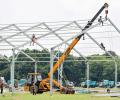
Kolkata's Brigade Parade Ground, a historic venue for political rallies and demonstrations, is set to host the swearing-in ceremony of Bengal's first BJP government, marking a significant shift in the state's political landscape. The ground has been a stage for political heavyweights and pivotal moments in Bengal's history.

Pakistan is playing a key role in facilitating talks between the US and Iran, but the future of these negotiations remains uncertain. Despite ongoing diplomatic efforts, no dates have been set for a second round of discussions.

Iran has formally turned down a proposal from the United States for a 48-hour ceasefire, according to Al Jazeera, citing reports from the semi-official Fars news agency.
China has called on Iran to reopen the Strait of Hormuz and expressed appreciation for Tehran's commitment not to develop nuclear weapons, a key demand of the US to end the conflict.

Iranian President Masoud Pezeshkian described Israel's incursions into Lebanon as a blatant breach of the ceasefire and said the continued attacks reflect deception and a lack of commitment to potential agreements.

Aamir Khan's upcoming film, aims to shed light on the 1952-1953 India-Pakistan series, which occurred just five years after Partition and marked Pakistan's first official Test series.

Donald Trump has expressed confidence that Tehran will engage in diplomatic talks, warning that the country will 'see problems' should it refuse to cooperate.

Pakistan's Prime Minister Shehbaz Sharif has engaged in extensive diplomatic efforts to de-escalate the conflict in West Asia, offering to host talks between the US and Iran and engaging with leaders from Saudi Arabia, Qatar, Malaysia, the UK, China, and the European Union.

Iran's foreign ministry spokesperson Esmaeil Baqaei on Sunday said that the recent meeting with US officials was the longest round of negotiations they have had in the past year.

Iran has put forward a comprehensive 10-point framework that it says forms the basis of a complete resolution.
Pakistan's Prime Minister Shehbaz Sharif has offered to mediate between the US and Iran to de-escalate the ongoing conflict in West Asia, following a joint US-Israel attack on Iran. Sharif has been in contact with Saudi Arabia, the UAE, and other nations to promote dialogue and diplomacy.

China has criticised the US blockade of the Strait of Hormuz, calling it a dangerous and irresponsible move, and urged Washington and Tehran to honour the ceasefire. Beijing also denied aiding Iran militarily and threatened countermeasures if the US imposes tariffs.

...reopen for up to six months. Until then, the Strait stays nearly closed. The world pays. And no one, including the man who started this, can say when it ends, notes Prem Panicker in his must read blog on the Iran War.

The question is whether the clocks allow enough time for two deeply mistrustful sides to get there, and whether the surface calm holds long enough for the paddling to produce something before the ceasefire ends on April 22, notes Prem Panicker in his must read blog on the Iran War.

Despite President Trump's optimistic prediction of a swift resolution to the ongoing conflict with Iran, Tehran dismisses any possibility of diplomatic breakthroughs, citing deep distrust and highlighting the complexities of US-Iran relations.

The Iranian Embassy in South Africa has launched a biting social media attack on US President Donald Trump, using a viral maritime audio clip to label him an "idiot".

Phunchuk Stobdan's forte was candour and strong views on India's defence. Naturally, India's adversaries were in awe of him, fearing his views and unyielding stand on boundary issues, remembers Tarun Vijay.

Indian benchmark stock indices, Sensex and Nifty, surged over 1 per cent, driven by optimism surrounding potential US-Iran peace talks and a significant drop in crude oil prices below the USD 100 per barrel mark. This de-escalation in geopolitical concerns and easing inflation pressures provided a substantial boost to investor sentiment.

Indian benchmark indices Sensex and Nifty experienced a significant tumble in early trade, driven by surging global oil prices, continuous outflows by Foreign Institutional Investors (FIIs), and persistent geopolitical uncertainties, particularly in West Asia.

Israeli Prime Minister Benjamin Netanyahu on Thursday called for the opening of direct negotiations with Lebanon, as tensions persist along the border despite a two-week ceasefire aimed at halting hostilities in West Asia.

India has criticised US President Donald Trump's social media repost referring to India and other countries as 'hellholes' in the context of immigration, deeming the remarks 'uninformed' and 'inappropriate'.

External Affairs Minister S Jaishankar spoke with his Portuguese counterpart Paulo Rangel to discuss the West Asia conflict and explore ways to enhance bilateral cooperation.

Canada's police chief states there is no current evidence of clandestine activities or transnational repression linked to the Indian government within Canada, amidst improving diplomatic relations between the two countries.

Defence Minister Rajnath Singh met his Chinese counterpart Admiral Dong Jun in Bishkek to discuss maintaining peace and tranquility along the Line of Actual Control (LAC) and broader regional security concerns.

China is mediating talks between Pakistan and Afghanistan to address their ongoing military conflict, following Pakistan's operation against terrorist hideouts in Afghanistan and UN reports questioning Pakistan's evidence of militant presence in Afghanistan.

Trump emphasised that diplomatic discussions remain ongoing. At the same time, he issued a stark warning, saying that failure to reach an agreement could trigger military action.

UN Secretary-General Antonio Guterres has expressed deep concern over US President Donald Trump's warning to Iran and appealed for the re-establishment of freedom of navigation in the Strait of Hormuz.

Amidst the escalating conflict in West Asia, India is actively engaged in diplomatic efforts to protect its energy security interests and ensure the safety of its diaspora in the region.

The meeting follows a ceasefire agreement that was announced and welcomed by Shehbaz Sharif, who also extended invitations to both delegations for further negotiations.
The Ministry of External Affairs (MEA) reports that over 1,150 Indian nationals have been evacuated from Iran through land borders into Armenia and Azerbaijan since the start of the West Asia conflict. The MEA also confirmed that three Indians were injured in attacks in the UAE.
